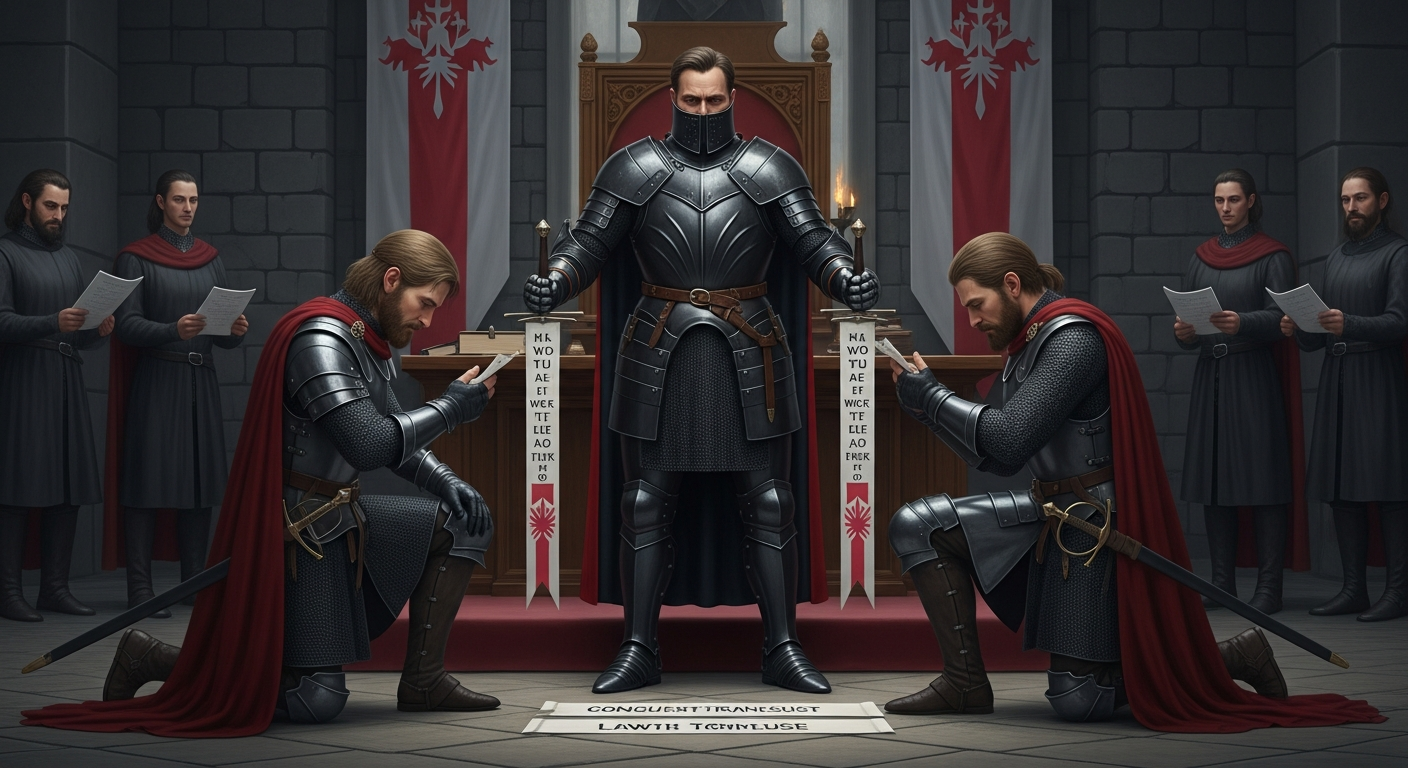
A legal sleight-of-hand worked out by Terleman in the Hedgemage civil war. Baron Astyral of Losara and Baron Gydion of Tantonel formally surrendered their Castali baronies to him under right of conquest; Terleman gifted them back under Alshari sovereignty and the two swore fealty to Duke Anguin instead of Prince Tavard. Two Castali domains lawfully transferred to Alshar in an afternoon, without a sword drawn.
The Astyral and Gydion Defection is the smartest single move of the Hedgemage civil war and was entirely a paperwork exercise. The mechanism: Viscount Terleman convinced two Castali barons who already preferred Alshari rule to formally surrender their baronies to him under right of conquest. Once surrendered, the baronies were his to dispose of. He gifted them back to the same barons immediately and accepted their fealty as Alshari vassals. The same lord, the same castle, the same peasants; a new duke and a new flag.
The two barons
Baron Astyral of Losara was the obvious candidate. Gilmoran-born, magelord, long-time member of Minalan's inner circle, holder of Losara by Duke Anguin's grant, and at that moment under attack by the Count of Dendra in a Tavard-aligned proxy war. Astyral had been functionally Alshari for years; the surrender-and-regrant simply made the law match the practice.
Baron Gydion of Tantonel was the more politically charged of the two. Gydion was Duke Anguin's bastard half-brother and personal bodyguard, holder of Tantonel by grant. His defection wasn't a swap of allegiances so much as a regularising of a fact already on the ground: a Castali barony held by an Alshari duke's brother.
How it worked
Right of conquest under Duin's Law required (a) a state of war, (b) a surrender, (c) the conqueror to hold the conquered fief for some non-trivial period. Tavard's secret declaration of war satisfied (a). Astyral and Gydion personally rode to Terleman's camp and tendered their formal surrenders, satisfying (b). Terleman accepted the surrenders, raised the Magelaw banner over each fief for a ceremonial period, and then formally gifted both back to their former lords as Alshari vassals, satisfying (c). Brother Bryte prepared the Writs of Conquest and the regrant deeds in the same packet and dispatched them to the Alshari court at Vorone.
The brilliance of the move is that nobody had to die and nobody had to be visibly disloyal. Astyral and Gydion did not break their oaths to Tavard; they were lawfully conquered and disenfranchised, then re-enfeoffed under a different sovereign. Their old oaths went with the old fiefs into the void. Their new oaths were to Anguin.
Reception
The Alshari court was overjoyed. Adding a Gilmoran barony and a Wilderlands barony to Alshar by lawful instrument, in the middle of a war Tavard had started, was a coup of a kind feudal politics almost never allowed. Tavard was incandescent. Rardine sent quiet correspondence to several other wavering Gilmoran houses suggesting the procedure might be replicated. King Rard, faced with a fait accompli in the names of two barons who had committed no actual treason and a viscount working strictly within the letter of Duin's Law, found nothing he could overturn. At the eventual Curia settlement the two transfers were the only ones Tavard explicitly conceded as permanent.
What it enabled
The defection set the template for the Benfradine duel a week later. Baron Maynard of Benfradine used a variation: rather than a quiet surrender he staged a public duel he intended to lose, which had the same legal effect (lawful conquest, regrant) while letting him claim he had been honourably defeated rather than politically opportunistic. By the time Tavard understood what was being done to him three baronies had switched sides and the precedent for others was visibly working.
Comments
Share your thoughts on this entry. Sign in with Google, Facebook, X (Twitter), or your Disqus account — we don't manage logins ourselves, and your account stays with the provider.