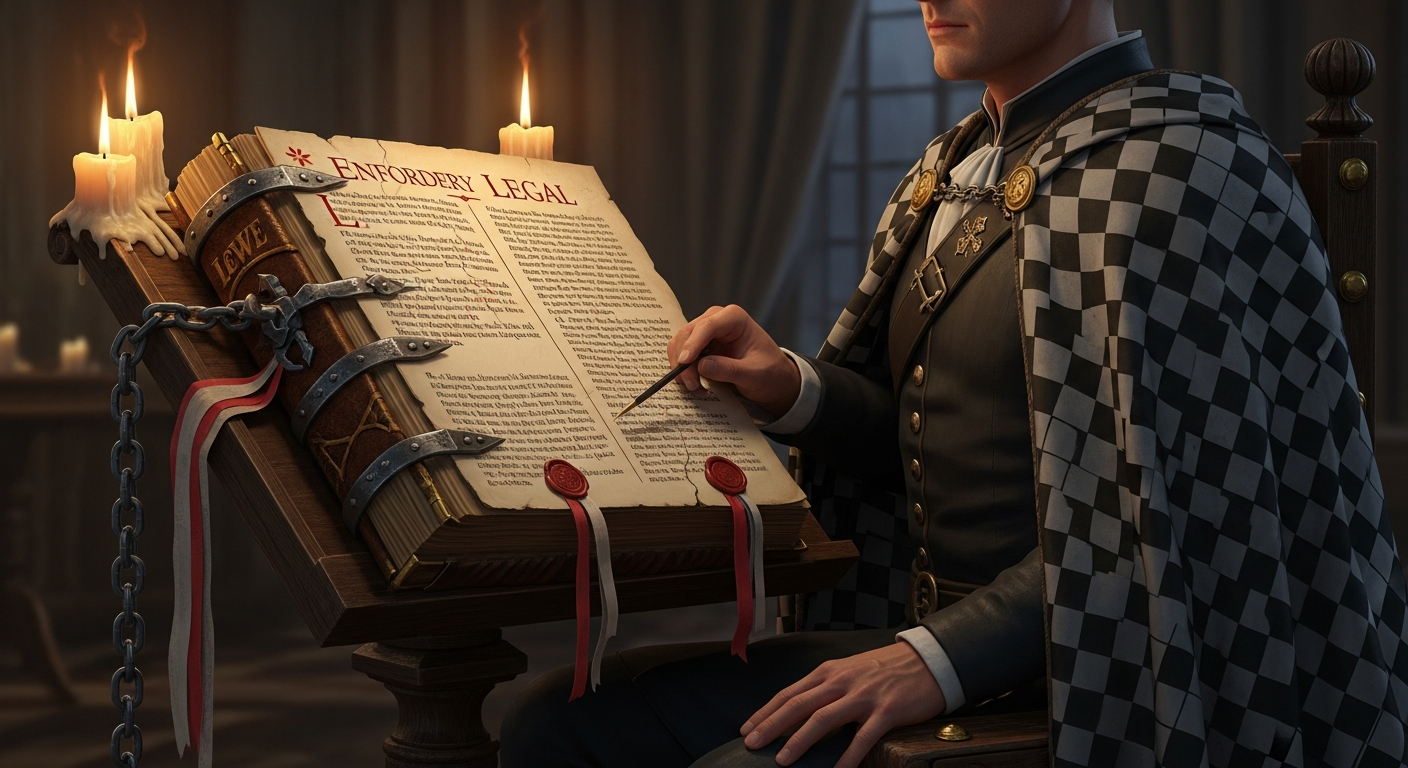
The four-century-old Imperial-then-Narasi legal framework that regulated every certified magus in the Five Duchies, prohibited magi from holding land or title, restricted irionite, and was enforced by the Royal Censorate of Magic. Established by King Kamaklaven after the fall of the Magocracy as a way to defang the conquered Imperial magelords; dissolved by King Rard at Minalan's urging during the founding of the Kingdom of Castalshar.
The Bans on Magic were the legal framework that governed every certified magus in the Five Duchies for nearly four centuries between the fall of the Magocracy and the founding of the Kingdom of Castalshar. The Bans were less a single law than a body of regulation: a working theory about what magic was for, who was allowed to practice it, and what civil station a practitioner could hold. They shaped every magus's career, including Minalan's, until Rard dissolved them.
Origins
The Bans were instituted by King Kamaklaven in the immediate aftermath of the Conquest, when the Narasi had broken the Magocracy in the field but the surviving Imperial magelords still constituted a substantial latent threat. Rather than execute them — politically impossible — or trust them — obviously unwise — Kamaklaven chose to uncouple their magical power from their temporal power. The strategic logic was straightforward:
When my ancestors slashed apart the Magocracy and built the Five Duchies on its ashes, the Bans had been designed to forestall the power of the remaining practicing magi in the East by uncoupling their magical power from their temporal power. If you were going to be certified a mage and licensed to practice by the fictitious Crown, then you couldn't inherit your ancestral estates, the law said, simple as that. And you couldn't buy them, or marry into them, either.
— Minalan, on the original logic of the Bans
The non-Talented members of Imperial noble houses kept the lands and the income; the Talented members got training and a livelihood but no political base. The Bans worked by impoverishing the magical class without ever lifting a sword.
What the Bans actually prohibited
The Bans were a sprawling body of regulation, but the operationally important provisions were:
- No magelords. A certified magus could not inherit, purchase, or marry into landed estates. A magus who came into a title (e.g. by surviving every other heir) had to either renounce magic or renounce the title.
- No irionite. All green-amber witchstones, by official decree, were either confiscated to the Empty Staff of the Archmage at Castabriel, destroyed, or had never legally existed. Possession of irionite was a capital offence under Censorate jurisdiction.
- Mandatory certification. Practising magic without an Academy charter and a Censorate licence was prohibited. The unregistered — hedgemages, footwizards, village witches, sport-Talents — were technically outlaws.
- No political activity. Magi were prohibited from interfering in temporal political affairs, from holding civic office, from advising sovereigns on questions outside narrow technical scope, and from joining political factions.
- Proscribed disciplines. Certain branches of magic — including most weapon-grade warmagic outside Ducal service, sex-magic on persons not consenting, prophecy in any form, and necromancy in every form — were proscribed outright.
- Censorate enforcement at any cost. The Royal Censors had the authority to order the death penalty, the burning-out of a magus's Talent, or revocation of certification, at their discretion in the field, with no appeal beyond the Censor General.
The Royal Censorate of Magic
Enforcement fell to the Royal Censorate of Magic — an elite order of certified magi who policed their own profession on the Crown's authority. The Censorate's structural cynicism was deliberate: it recruited young, idealistic, not terribly bright magi fresh out of school, formed them into incorruptible zealots, dressed them in black-and-white checkered cloaks that announced their authority on sight, and dispatched them across the Duchies with discretionary kill-power and substantial Coronet stipends.
Most of the Censorate's working life was spent rounding up the unregistered (hedgewitches, footwizards, illegitimate practitioners) and burning them out or hanging them. Many of the renegade warmagi Minalan later recruited — including Bendonal the Outlaw — had been on the Censorate's warrant lists for years.
The unwritten effect
The Bans had three structural effects that lasted the full four centuries:
- The magi were impoverished as a class. A certified magus could earn a wage but not build a hereditary estate. Their political weight was negligible.
- The magi were professionally isolated. Without political alliances, they could not protect themselves from the Censorate; without estates, they could not afford the libraries, laboratories, and apprenticeships that produced great magic.
- The magical knowledge of the Magocracy decayed in slow-motion. Each generation knew less than the last, because the funded research apparatus that had sustained Imperial magic no longer existed. By Minalan's time, even Inarion Academy could only teach a fragment of what the original Magocracy had known. Books, spells, and entire schools had been lost.
The slow professional erosion was the Bans' most successful achievement. By the time the gurvani invasion came, the Five Duchies had fewer trained magi, with thinner libraries and less power per practitioner, than at any point in living memory.
The relaxation
The Bans were dissolved in stages over the course of Warmage through the early Magelord volumes. Minalan brought the demand to the Coronet Council in person before the Battle of Timberwatch:
For centuries, now, our profession has been hampered by the Bans. Understandably -- the wars between magelords nearly ruined the East, before the invasions. Controlling the mage folk made sense when the Easterners were rebelling and plotting revolt every six months. . . . The Bans didn't make sense anymore -- at least, not as they had been decreed. We would need every magus in the Five Duchies if we were going to counter this threat.
— Minalan, presenting the case to the Coronet Council
The price Minalan demanded for the Magical Corps's continued service was specific: lift the Bans on landholding and inheritance, abolish the political-activity restriction, and let warmagi take fiefs as Magelords on the Riverlands and Wilderlands frontiers. Duke Rard, faced with a goblin invasion he could not stop without warmagi, agreed.
Master Dunselen, the Castali Court Wizard, called the proposal anarchy:
To relax the Bans? That is unthinkable! Who will hold the misuse of magic accountable? Who will license and regulate magi? Relaxing the Bans would be . . . it would be anarchy!
— Master Dunselen, in council
Minalan answered with the proposal that became the Arcane Orders:
I will take the place of the Bans to ensure their accountability.
— Minalan
The framework that emerged: every recipient of a witchstone swore an oath to Minalan personally, surrenderable on demand. The Arcane Orders (Hesian, Horkan, Mandros, Tarkarine, Secret Tower) replaced the Censorate as the magi's self-regulating profession. Magelord baronies (Sevendor first, then dozens more) replaced the Bans' prohibition on landholding. The Censorate itself was dissolved by writ of the King at the founding of the Kingdom of Castalshar.
The Censorate of Magic no longer exists in the Kingdom of Castalshar. It has been dissolved by writ of the King.
— Minalan to Censor Commander Arlof at the close of the Siege of Sevendor
What followed
The lifting of the Bans transformed the Five Duchies in less than a decade:
- The magelord baronies proliferated: by the time of the Restoration of Anguin, magelords held substantial portions of the Bontal Vales, the Magelaw, and reconquered Gilmora.
- Hedgewitches and footwizards emerged from hiding by the score. Hidden practitioners who had spent their careers on the run came to Sevendor and the Magical Fair to register and acquire legitimacy. Many were quietly Talented and produced the next generation of working magi.
- The Arcane Orders became the de facto regulatory body for the profession. Their internal politics, their economics, and their relationships to the Crown and the Coronet Council ran most of the books that followed.
- The professional magical class began to recover the knowledge it had lost over the four-century erosion. Pentandra's sex-magic discipline, Carmella's engineering thaumaturgy, Heeth's arcanism, and the entire snowstone-witchstone trade became open fields of research for the first time since the Magocracy.
The Bans's afterlife
The Censorate did not vanish entirely. Its diehards withdrew to Farise — the southern Imperial Commonwealth where the Five Duchies' writ did not run — and continued to operate as the Farisi Censorate, a parallel institution that retained its old hostility to irionite and to the Magelords. The Censorate's remnants surface periodically through the rest of the series: hunting hedgewitches like Antimei through her Wilderlands croft, harassing Alshari refugees, and finally surrendering in the Election of Doge Mirkandar when their last Farisi base was politically dissolved.
The Bans themselves are still cited in legal scholarship as an example of how completely a regulatory regime can be reversed. By the close of the series the conventional view was that the Bans had been an instrument of dynastic stability that had outlived its purpose by two centuries before Minalan finally insisted on their end.
Comments
Share your thoughts on this entry. Sign in with Google, Facebook, X (Twitter), or your Disqus account — we don't manage logins ourselves, and your account stays with the provider.