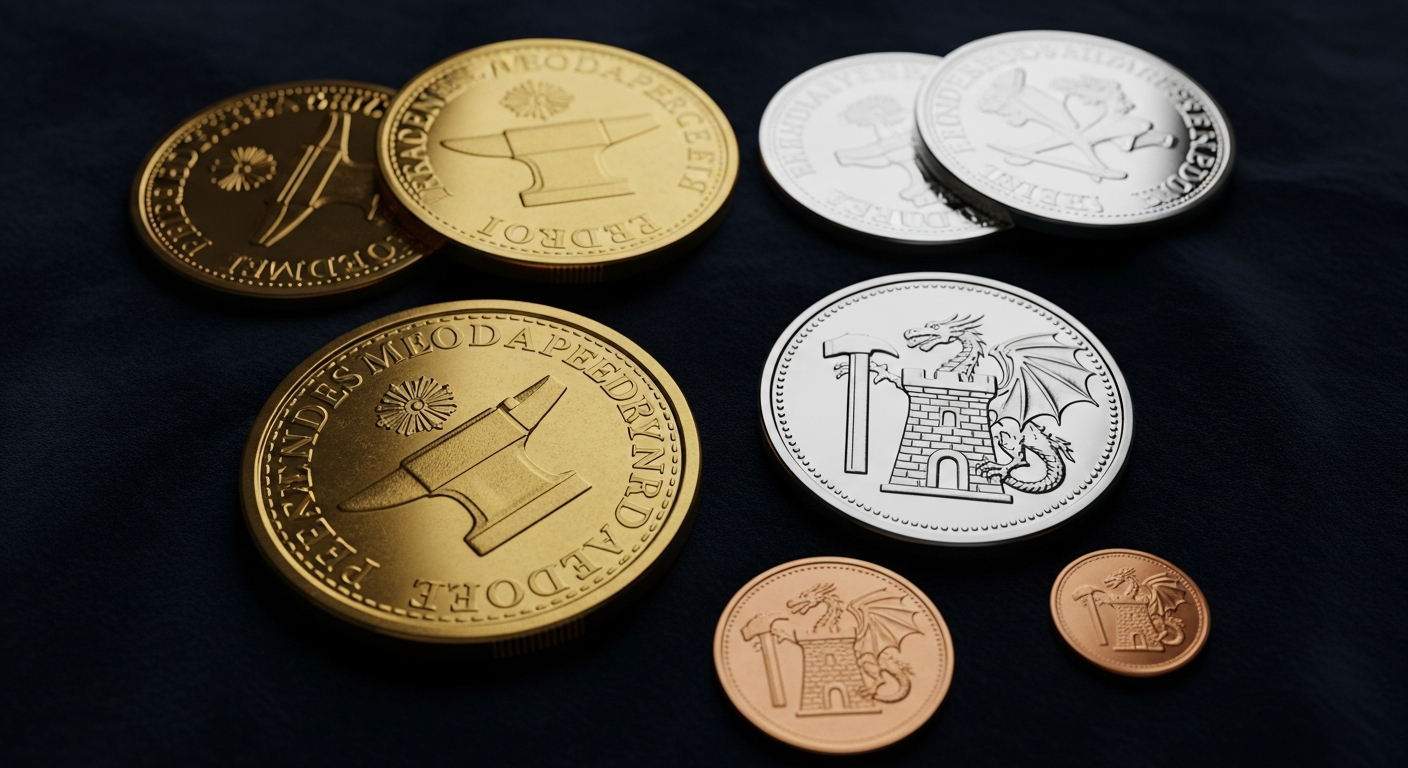
The full-denomination Magelaw coinage minted by Banamor and the Karshak lapidaries from Vundel bullion — Anvils, Knots, Hammers, Towers, and Dragons, each mage-hardened against wear and counterfeit.
One of the unusual privileges of Minalan's Count Palatine status is the right to mint his own coinage. In Thaumaturge, Minalan turns that right into a full monetary reform for the Wilderlands. The region had suffered a chronic dearth of good coin: before the invasion the most common piece in the Wilderlands was an iron slug theoretically worth one-tenth of one copper penny, whose actual value "depended upon who was doing the accounting." Larger transactions were counted in half-ounce copper Starlings and one-ounce copper Bells of uncertain exchange, and silver was rarer than trust.
Minalan funded the new coinage from the Vundel's payment for Sevendor mountain — spheres of gold, silver, and copper bullion traded for his snowstone. Banamor ran the project, enlisting the Karshak lapidaries (on unusual terms — stoneworkers reluctantly agreeing to dabble in metal); the Lord Mayor of Sevendor Town contributed practical suggestions on size and denomination. Minalan's own account from his notebooks lays out the thinking:
As Count Palatine of the Magelaw, it was within the scope of my rights to coin money, a highly-coveted and oft-abused right among the senior nobility... I knew from setting up shop as a spellmonger in Boval Vale that the Wilderlands had always suffered a dearth of good coin.Minalan, Thaumaturge
The five denominations
Anvils. The workhorse of the market. A one-tenth-ounce copper penny strengthened with just enough nickel to keep it hard. The obverse carries Pentandra's new anvil device, the reverse "a flattering silhouette of the Baroness of Vanador."
Knots. A heavy one-ounce copper coin inscribed with Baron Arborn of Lotanz's square-knot device and a fair profile of him, with the Kasari motto across the reverse for exotic flare.
Hammers. The smaller silver coin of the series. Ten Hammers exchanged for one Tower.
Towers. A full one-ounce silver coin bearing a stylised pele tower. Minted in series, each issue naming a different mage's tower on the obverse with the tower-keeper's name on the reverse — Salik Tower, Traveler's Tower, Rognar Tower, and so on. Ten Hammers equalled one Tower; twenty Towers bought one Dragon.
Dragons. The gold coin of the Magelaw. A full ounce of gold, worth twenty Towers, struck with a dragon skull on the obverse (honouring the attack on Vorone) and Minalan's own profile on the reverse. "I looked quite regal in gold, I thought."
The enchantments
The Magelaw's coins are enchanted as a matter of policy. Each coin is mage-hardened against surface wear, so that after hundreds of transactions the designs remain "as sharp and clear as they were when minted." The enchantment also prevents melting — the metal cannot be rendered down until the enchantment is broken, which costs an enormous amount of fuel. Silver coins resist tarnish; copper coins resist corrosion. Any lord tempted to debase or re-strike them simply finds the process uneconomical.
Politically the reform was a sovereignty statement as much as an economic one. Striking Magelaw coin asserts Minalan's Count Palatine independence; accepting it across the Wilderlands, Vorone, and Sevendor binds the economic lives of those regions to the new province. By Arcanist the coins circulate freely with Castali and Alshari currency, and the Magelaw's reserves become a standard component of any major transaction along the northern frontier.
Comments
Share your thoughts on this entry. Sign in with Google, Facebook, X (Twitter), or your Disqus account — we don't manage logins ourselves, and your account stays with the provider.