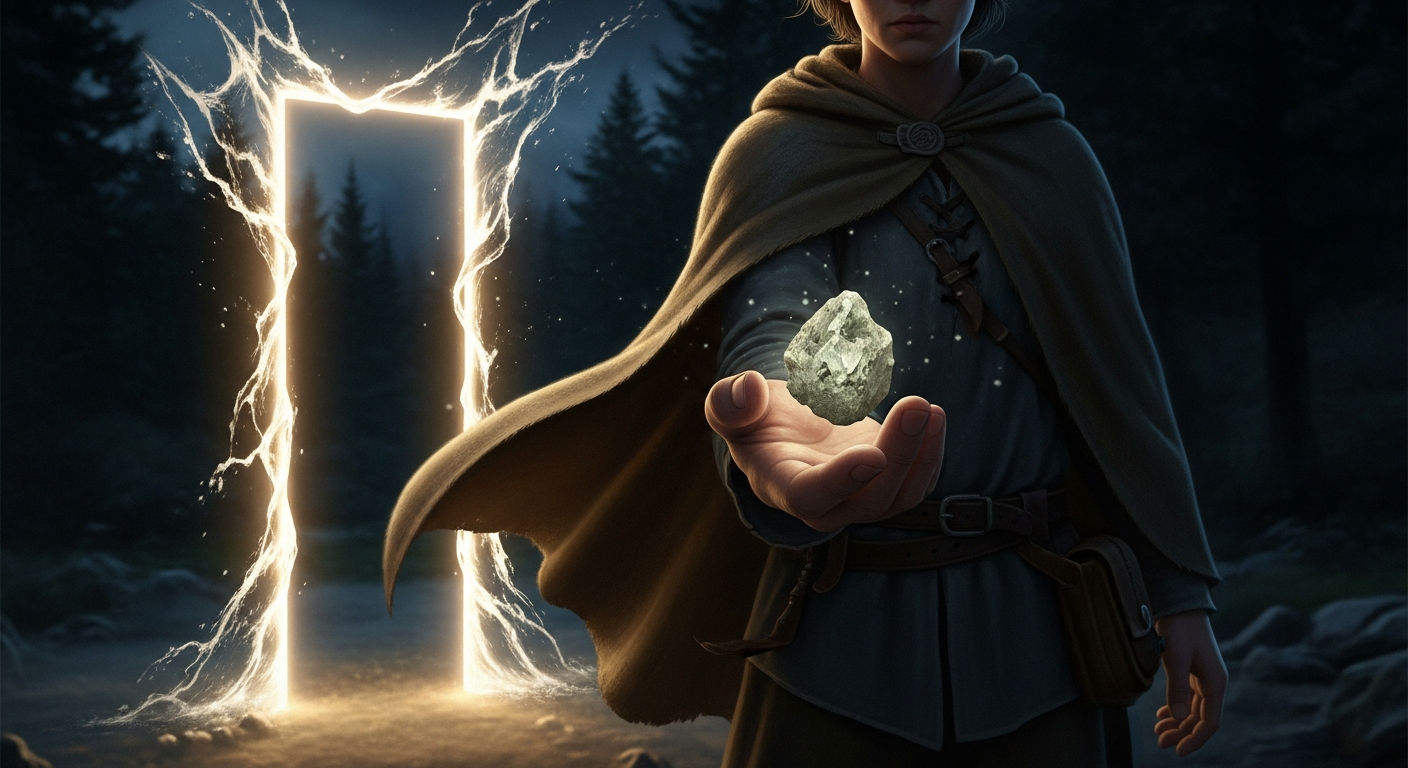
The teleportation-network technology of the Magelord era. A Waystone is an enchanted anchor that establishes a fixed coordinate in the magosphere; a properly-trained mage can travel between Waystones via the Ways. Built on snowstone substrate for portability; the Magelaw network is the largest deployment in the Five Duchies and the strategic backbone of the kingdom's post-Restoration politics.
Waystones — sometimes called Waypoints, with the network as the Ways — are the teleportation-anchor technology that defines the Magelord era. A Waystone establishes a fixed coordinate in the magosphere; a properly-trained mage carrying a witchstone can travel between Waystones almost instantly via the Ways, bypassing the conventional travel times that constrained pre-saga warfare and politics.
Origins
Waystone technology has two distinct layers of origin. Static Waystones — fixed installations anchored to natural Waypoints — were already known to and used by the Alka Alon long before the events of the saga. The breakthrough attributed to Minalan and his Karshak (Wood Dwarf) allies was the development of mobile Waystones: portable crystals not dependent on a pre-existing natural Waypoint. Lady Varen of the Alka Alon personally taught Minalan the art of navigating the Ways, providing the foundational knowledge he and the Karshak then extended to mobile anchors. The practical substrate breakthrough was the recognition that snowstone provides an extremely stable enchantment base; Pentandra and Taren contributed substantially to the subsequent thaumaturgical engineering and scaling work. The original Snowstone Event made the technology economically possible; the Vanador Snowstone Event (and the deliberate snowstone-spell protocol) made it scalable.
How they work
A Waystone is typically a fragment of snowstone (sometimes a few inches across, sometimes much smaller) bound by an enchantment that establishes its anchor-coordinate. To travel:
- The traveling mage focuses on the destination Waystone via mental link.
- They engage the Ways with their personal witchstone, drawing power.
- The traveler steps through to the destination instantly.
Travel is one-way per cast: arrival at the destination Waystone, with the option to immediately return only if the traveler can re-engage the Ways. Carrying multiple passengers requires substantial extra power; a witchsphere-class artefact can carry a handful of people simultaneously.
Strategic significance
The Waystone network is the strategic backbone of late-saga Castalshar:
- Magelaw warmagi can move between Vanador, Sevendor, Falas, Tudry, and the Penumbra forts in moments rather than weeks.
- The four-prong Olum Seheri operation was made possible by Waystone-coordinated simultaneous deployment.
- The Darkfaller relief portal arch was a fixed-Waystone installation.
- Sevendor's permanent portal arch links to Vanador, Falas, Castabriel, and other regional centres.
The technology transforms how nobles interact: Duke Anguin can hold Vorone, Falas, and the Magelaw simultaneously through Pentandra's Mirror-Array-and-Ways combination; Minalan can run his Magelaw, his Sevendor demesne, and his Farisi affairs from any one of them.
Ways-blocks
Hostile parties can construct Way-blocks — necromantic counters that disrupt arrival at warded Waystones. Korbal's Olum Seheri, Mycin Amana's Darkfaller, and other major enemy seats have all deployed Ways-blocks. The countermeasure is the portal arch (a Sevendor invention): a stone archway anchored to a Magolith-Waypoint working that bypasses local Ways-blocks by piggybacking on the Magolith's own thaumaturgical authority.
Comments
Share your thoughts on this entry. Sign in with Google, Facebook, X (Twitter), or your Disqus account — we don't manage logins ourselves, and your account stays with the provider.