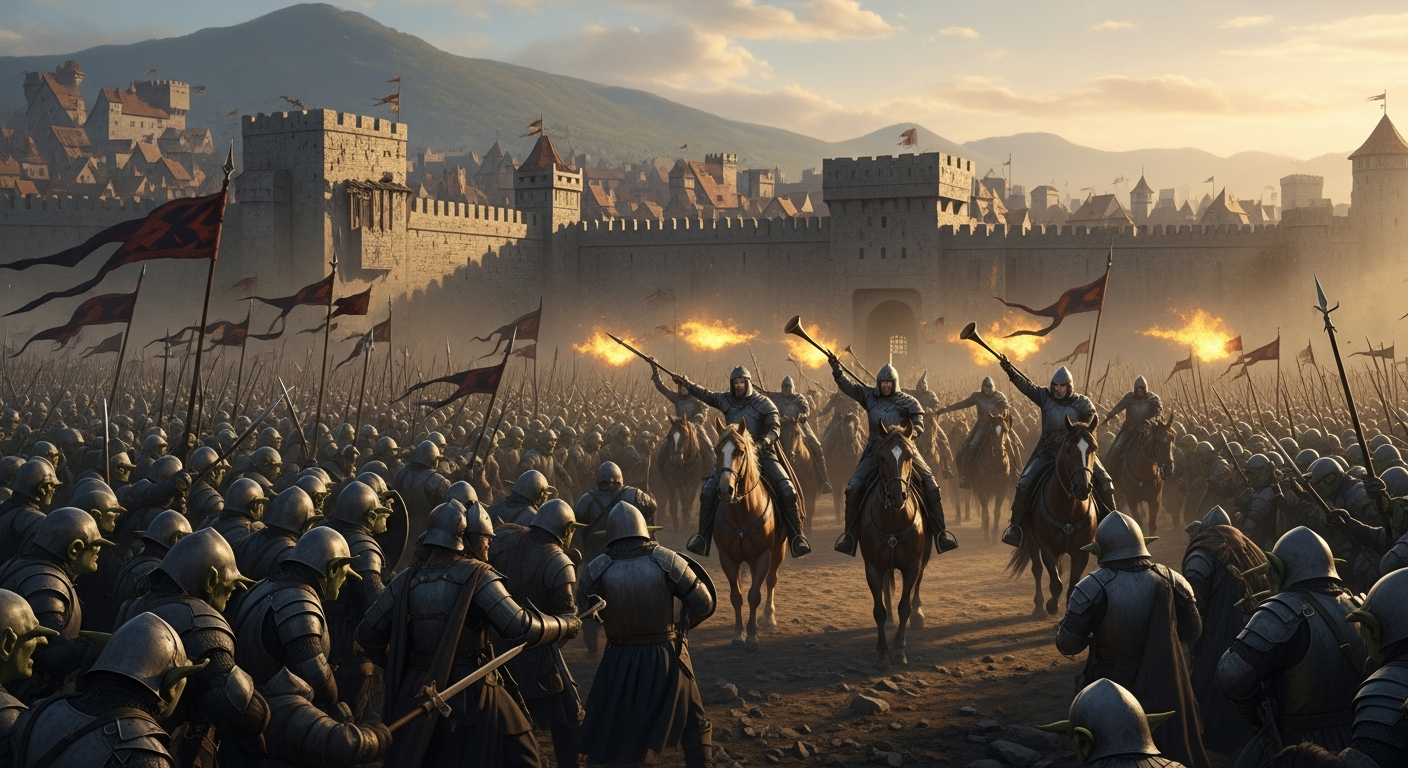
Some ten thousand gurvani encircled the chartered city of Tudry while Duke Lenguin of Alshar refused to send relief from Vorone. Minalan and a coalition of warmagi, mercenary companies, and the heavy cavalry of the Baron of Megelin coordinated a relief battle that broke the siege. After the battle, Azar burned the Lord Mayor of Tudry alive in council for invoking the Bans on Magic. Civil control passed to Captain Volerin of the City Guard; military command was given to Astyral, who would hold it for the rest of the early war. Tudry became the warmagi's forward base for the entire Penumbra war that followed.
The Siege of Tudry was the first defining engagement of Minalan's nascent command. Tudry, the chartered city at the fork of the Anfal and the Moran, held some thirty thousand souls behind its walls — militia, refugees from the fallen western fiefs of Glandon and Farenrose, and a dwindling garrison of city watch. Beyond its walls some ten thousand gurvani had massed and were systematically blockading the roads to starve the city out.
Duke Lenguin of Alshar, in his northern capital at Vorone, had decided Tudry was lost. Rather than commit his fielded army to relieve it, he recalled his own bannermen away from the city, leaving only the militia and a handful of mercenaries inside the walls. As Hesia and Horka reported back from a reconnaissance of Vorone disguised as beggars:
The Duke refused to send a force to relieve Tudry, in fear of leaving Vorone defenseless. In essence, he had committed to abandoning Tudry so that he had more time to prepare to defend his northern capital.
— Hesia and Horka, on the Alshari court
Minalan, freshly arrived in Castal as a Castali ducal vassal but with no orders covering Alshari soil, decided that abandoning thirty thousand people in the same duchy he had just escaped from was not a policy he was prepared to honour.
The coalition
The relief plan was an improvised three-front coordination, every piece of it borrowed:
- Inside the walls: Astyral the Gilmoran was sent into Tudry openly, as Minalan's emissary, to coordinate with the local defence commander and the town council. The Tudrymen militia was reorganised under his oversight enough to march out of their own gates as drilled infantry rather than a panicked mob. Master Cormaran, an old retired warmage and master enchanter resident in Tudry, was given a witchstone, augmented to High Mage status, and put to work forging mageblades that would arm the leadership of every warmagi unit for the next decade.
- Mercenary infantry from the south: the Orphan's Band and the Warbirds, two large independent companies, were hired to flank the southern gurvani band along the Great Western Road.
- Heavy cavalry from the north: the Baron of Megelin agreed to commit nine hundred heavy horse, with Azar riding among them as warmage support, on a single coordinated charge from the northern road.
Minalan's problem was timing. The Tudrymen would need to march out of their own gates first, drawing the southern gurvani band onto the field; the mercenary infantry from the south needed to flank the southern band before it could collapse the Tudrymen; and the Megelini knights needed to charge the northern band from behind, at full lance, at exactly the moment the northern band moved south to support its colleagues. If any of those three pieces was off, the relief would fail and Tudry would fall.
The relief battle
At dawn the gates of Tudry opened. A long column of militia in ringed jacks and helmets, peasant spears and a few mageblades, marched out under the eyes of the encircling goblins. The southern band took the bait at once and charged, expecting an unsupported column.
The Orphan's Band and the Warbirds came up the road behind them and pinned the gurvani between two fronts. The northern band, unable to ignore the fight, moved south to reinforce. As soon as it cleared its blockade position, the horns of Megelin sounded and nine hundred lances thundered down out of the northern hills with Azar in among them.
The northern band's centre was decimated by the second volley of Megelin's horse archers and broken by the third with a lance charge. The southern band, learning what disciplined infantry and archers could do under warmage cover, was annihilated. The main horde east of the river, recognising the disaster too late, attempted to ford in support and was cut to pieces by the Magical Corps holding the bank.
The post-battle council and the burning of Lord Gesaran
Minalan kept the Orphans and the Nirodi mercenaries on the field policing the corpses, deliberately keeping the Tudrymen out of the looting so that any obvious heirlooms would be returned to noble kin. Half the Tudrymen militia chose to escort their families to Vorone afterward; the other half stayed at the wall as the new permanent garrison. The political question was what kind of city Tudry was going to be after the relief. Minalan convened a council with the Lord Mayor and the surviving guild leadership.
The Lord Mayor, Lord Gesaran, was not in a cooperative mood. He repeatedly invoked Tudry's charter, the city's independent civil authority, the Ducal precedent, and finally the Bans on Magic. The last one was a mistake.
If I hear one more word about the Bans, I'm going to get angry. When I get angry, I lose control. When I lose control . . . empires topple.
— Azar, warning Lord Gesaran
Lord Gesaran ignored the warning. He continued his speech: "It's a violation of our charter, it's an usurpation of Ducal authority and traditional rules of inheritance, it violates the Bans on Magic, and it will invite the Censorate down on—"
He never finished. Azar sheathed a warwand in its holster, having burst Lord Gesaran into a single intense column of flame that consumed him utterly in one terrified scream. The Lord Mayor of Tudry was a smouldering pile on the council-chamber floor before anyone in the room could call for water.
I warned him. He mentioned the Bans again, and I warned him. You all heard me. I can't be held responsible for that — if I tell a man I'll kill him if he does something, I have to back it up, don't I?
— Azar, after burning Lord Gesaran alive
The civic effect was immediate. Minalan — quietly noting that he had not wanted Lord Gesaran dead but recognising the political opportunity — announced the new arrangement with the corpse smouldering at his feet:
- Tudry's charter was suspended; the city would now be a military garrison and a forward magical base.
- Civil administration went to Captain Volerin of the City Guard, who had been standing in the room and was selected on the spot. Volerin was given private instructions from Minalan after the council adjourned.
- Military command went to Master Astyral, the Gilmoran warmage. Astyral would cobble together a working civil-military administration out of the wreckage of the old guild government over the months that followed, working with Captain Volerin and the surviving guild leadership.
- Azar was assigned to the Megelin command, where he and (in time) Bendonal the Outlaw would build the eastern Penumbra fortress system.
The new arrangement was unprecedented under the (then-still-formally-extant) Bans on Magic. Master Cormaran's workshop on the city's artisan street became the working forge of hundreds of mageblades — including Minalan's own — for the next several years. The Horkan Order, when it was founded, took up large quarters in Tudry; Astyral was eventually made formal Magelord of Tudry in the post-war reorganisation.
The political problem
Tudry also became the political problem the relief had not solved. With five thousand Tudrymen and Alshari refugee peasants drilling themselves for war, in a duchy whose own duke had abandoned them, sedition was inevitable. Minalan would later use exactly that fact to leverage Lenguin into committing his troops at the larger battle that followed:
Then the talk of sedition will begin, and the wise among your nobles will not deny it, and then eventually rebellion — you have five thousand Tudrymen and Alshari peasants who are drilling themselves for war even now, without your leave or encouragement. What do you think they will believe?
— Minalan to Duke Lenguin
The Siege of Tudry was the engagement that made Minalan a credible field commander, established the Magical Corps as a real military formation, made Master Cormaran the principal armourer of the war, and set the political ground for the great pitched battle north of Tudry the following year that closed the early war.
Comments
Share your thoughts on this entry. Sign in with Google, Facebook, X (Twitter), or your Disqus account — we don't manage logins ourselves, and your account stays with the provider.